
NEB Festival Blog by Dr James Bonner, Part 2
Introduction
UKRI were delighted to enable a cohort of UK researchers and innovators to attend the New European Bauhaus Festival (NEB) in June. We are grateful to Dr James Bonner, Knowledge Exchange Fellow at the University of Strathclyde in Glasgow for blogging below about his experiences of attending, travelling to the event in Brussels by cycling and using public transport.
Last time in Part 1, James blogged about leaving Glasgow two weeks before the NEB Festival began making a multi-modal transport journey cycling across the South-East corner of the UK, sailing to Dunkirk, Ostend, and cycling through Ghent, via Antwerp, Rotterdam and heading towards Brussels.
He described the continuity such travel gives with a progressive transition of movement in his case of place and water through cycling and connecting with people, places and ideas along the way.
Here James is soon to arrive in Brussels ready to take part in the NEB Festival, a platform for change makers to collaborate to bring about a thriving society and a just transition with a sense of local belonging and identity. Here are his impressions…
Utrecht to Brussels
From Rotterdam I made a 1-day train visit to Utrecht (I needed a bit of cycling rest) to visit a friend, but also to reengage with Utrecht, one of my favourite cities. It increasingly tops lists of best cycling cities in the world, even ahead of Amsterdam and Copenhagen. It really is quite somewhere. I cycled at 8.30 in the morning through the ‘rush hour’, which is an experience, but notable for how ‘quiet’ it is. Utrecht central station has an underground cycle parking facility that really is out of (or under) this world that can park over 10,000 bikes, and is a multi-layered network of bike lanes and parking spots. My mind does drift to the cycle parking provision in Glasgow Central Station… Let’s just say there’s some room for improvement.
After a quick visit to the nearby town of Delft to meet a connection from the University of Leiden (and some very wet weather), I took the train from Rotterdam to Brussels, and back towards Belgium…
Arriving in Brussels
The water story continued, as alighting the train at Brussels I was caught in a massive thunderstorm.
Brussels, compared to Dutch cities, is a bit more chaotic, and cycling a bit more ‘exciting’. The added energy of the storm, and with water streaming down the roads from the thundery downpour, amplified this. Traffic was snarling up in the city, and speaks of mobility challenges in the changing climate coupled with the design challenges of infrastructure.
I found my way to the edge of the city through the traffic to my accommodation. Tonight was the opening game of the World Cup- Mexico v South Africa.
NEB Festival ideas and connections
This visit was a confluence of past and present reasons for coming to Brussels, including my post-doctoral academic work in place, mobility, water and sustainability research. Representing colleagues from the University of Strathclyde, where we seek to build a consortium and apply for a NEB project Understanding inhabitant’s experiences of neighbourhoods to support their health and well-being: HORIZON-NEB-2026-01-PARTICIPATION-03 in this year’s NEB call, I had come to learn, share, and make friends.
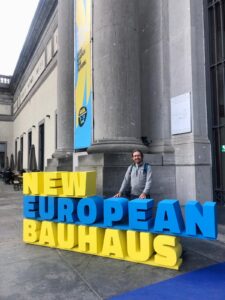
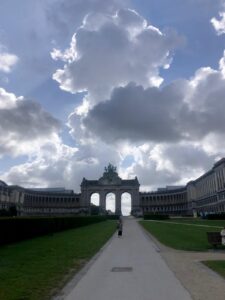
Over the next three days I would attend the NEB festival at the Belgian Museum of Fine Arts – one of the city’s most notable landmarks. On my first day I met a colleague from Barcelona who is helping project manage our forthcoming bid, and we walked the central avenue of the Parc du Cinquaternine to the Museum.
The NEB Festival had taken over the museum, and it was an incredible location to be mixing talks, workshops, performances and exhibits against the backdrop of huge stone sculptures, and walls adorned with paintings. I attended a number of talks, as well as the impressive NEB Fair of projects showcasing their work. It was a great opportunity to see the work that was being undertaken in NEB projects, get valuable advice and guidance from attendees about specific aspects of their work, and make some contacts who could be potential partners.
From the day, I could sense some the themes that the NEB embraced – from the blue and orange gowned leader of the the festival, to noticing attendees dressed in artistic costumes and sculpted hats – from violins (or maybe was it a cello?) to vegetables… This nod and inclusion of colour, fun, expression and the arts was evidently ingrained in the NEB. It seems important to foreground that in applications and projects.
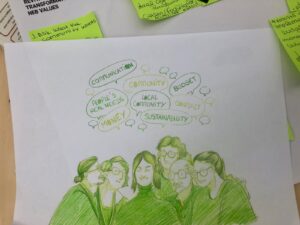
On my second day it was more talks, plus also attendance at a number of workshops, in particular the really enjoyable ‘BAUHAUS4EU European University approach to Regional Living Labs’ workshop where we undertook a role playing exercise as participants designing a community recreational project. I really enjoyed this fun and interactive approach, including the excellent artistic drawings of our interactions by students from Amiens in France! These ways of recording combine knowledge and practice in exciting and engaging formats that are so valuable.
More generally, a significant take away I took from my attendance and speaking with people was the need for me to continually speak about the UK’s ability to participate (indeed lead) NEB projects in a post Brexit world. This is a big task for UK institutions – to really reinforce that message, and our keenness to (re)build relationships with partners across Europe.
Heading back home
From Brussels I take a Eurostar train back to London, and doing this with a bike requires a bit of forward planning. Emerging out of St Pancras Station in London it is exciting to be back in a city so full of culture. In the serendipity of movement by bike, it is the premier of the documentary film ‘Time and Water’ that evening – a book I had read years before, which had a profound effect on me. A story from Iceland about the loss of a glacier, and of family memories that are melting away with time.
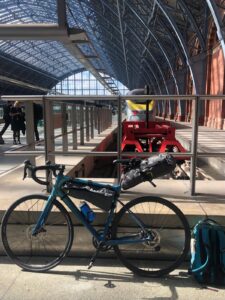
From London I took a train back to Glasgow, arriving just a few hours before Scotland played in its opening game of the football World Cup. So full of hope!
Reflecting back on my time at NEB festival, and even more so the journey and movements to and around it by bike, offered so many opportunities for learning and experience- a practice of ‘Slow Travel/Research’. The value of coming across events like ‘Walk the Block’ in Rotterdam, to sharing conversations with other cyclists waiting in the queue to board our ferry at Dover, or meeting a Belgian student in a cafe somewhere north of Ghent to talk about our mutual forms of research, is a favourite aspect about moving by bike.
Unexpected encounters and serendipitous eventualities seem to arise when you move in this quite unstructured way. By bike you are so close and proximate to place, moving through it at a pace where you can observe and encounter things at a human level. What can we learn from each other, and different places, when we imagine, plan and design for the worlds we want to live in? Can moving like this help?
I come back from the NEB festival, and my broader journey, fresh with ideas and observed practices about places and people, and that I hope will enhance my contribution to the call we are applying to that pertains to inhabitant’s experiences, neighbourhoods, health and well-being.
For me, moving, meeting, observing and reflecting in this way helps nurture a critical perspective and a more intimate understanding of places, and where I find myself often always asking why things are as they are. What are creative, inclusive and sustainable approaches that might make them otherwise if they are not quite doing this?
That, fundamentally, seems like what the spirit of the NEB is all about…
(N.B. With thanks to James for contributing this blog, and a note that he is happy to be contacted about any aspect of his research work. See the links in part 1 of this blog series.)
[Ends]