
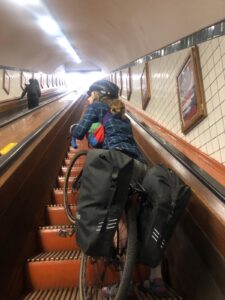
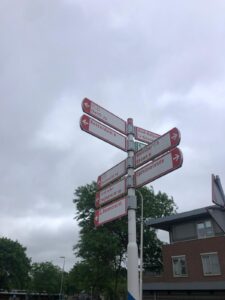
NEB Festival Blog by Dr James Bonner, Part 1
Introduction
James is supporting colleagues on a NEB bid on the call ‘Understanding inhabitant’s experiences of neighbourhoods to support their health and well-being: HORIZON-NEB-2026-01-PARTICIPATION-03′.
His work crosses and interlinks between different disciplines in the broad area of sustainability in the context of places. He is specifically interested in trees, water and cycling – this is often an easier summary for opening conversations! He particularly draws on critical and interpretive perspectives and methodological practices in his research and work.
James travelled to the NEB festival in Brussels using a combination of public transport and bicycle. In addition to representing his colleagues on the aforementioned Horizon call, he took it as an opportunity to share and connect on the methodological practices he is exploring in Scotland and elsewhere in Europe. He mostly likes to be outside exploring the world whatever the weather, and he says his cycling is, to be honest, mostly just long routes to cafes.
James’ research profile and projects: https://pureportal.strath.ac.uk/en/persons/james-bonner/
Instagram: @couchtocairn and @strathactivemobilityhub
European connections: A growing attachment to Belgium
Brussels is a city, and Belgium a country, I have visited many times since I first stumbled around it as a stary-eyed backpacker on my first Interrail trip in the early 2000s. I’d no mobile phone, a few travellers’ cheques, a ‘Lonely Planet’ guidebook, and a Thomas Cook European Timetable for 2003-4 (yes, an actual book of train timetables).
Maybe because it was at the end of a 6-week jaunt visiting as many of the big cities in Europe that I could, I was a bit tired out. And the city didn’t leave much of an impression on me.
But Brussels, and Belgium more generally, are places that have grown on me every time I have revisited. From travelling there for work, as a transport consultant on an FP7 project about carbon reduction choices in transport, to a number of recent cycling touring journeys – there’s something appealing in the Belgian way of life and the aesthetics and ambiance of Brussels itself. I like that, when in Brussels, I can at least order a train ticket and meal in my high school French- admittedly my Flemish needs a lot of work. Some of the art galleries of the city and nearby – such as the Magritte museum – seem to say something very Belgian. Food, art, coffee and a healthy dose of self-deprecation.
Attending the NEB Festival by bike and public transport
On 9-12 June I attended the NEB Festival at the incredible Art & History Museum in the city’s Parc du Cinquantenaire.
Hydro-cycles: journeys by bike and water
My journey had started in Glasgow a couple of weeks before the NEB Festival itself. Packing my bike, and after a ‘cheerio’ from colleagues from my favourite café in Glasgow, I took a train to London. Stopping there for a day to criss-cross the city on its canals on hired ‘Brompton’ bikes with a friend, before picking up on a journey I had been undertaking over a few visits to this part of the world, following the River Thames by bike. Escaping London on two wheels takes time, and you realise what a massive city it is, as I tried to navigate along with the river working my way east to the sea. Leaving the River Thames I headed south over rolling hills to the historic Canterbury, and from there to the port of Dover.
From here I took the 2-hour sailing to Dunkirk on the French north coast. Dunkirk has been proposed as a port for a new passenger and vehicle ferry connection with Rosyth on Scotland’s east coast. Such a connection could link long distance active mobility to public transport with exciting possibilities for cultural exchange (Explored in previous work: From the Rhins to Rhine).
Cycling on to, and then off, a ferry gives a ‘continuity’ to long distance travel that, for example, flying does not. Rather than leaving one place and then finding yourself in some other many kilometres away, the transition of movement is more progressive as you move across borders and regions. It offers opportunity for learning and observing these incremental changes in places, as town and cities merge into the countryside and countries and regions switch as you move across and along borders (I explore some of these issues in a recorded seminar for University of Strathclyde’s European Policies Research Centre.) What is more, packing a bike to go on a plane is a complete hassle and expense, and I’d rather not deal with that…
From Dunkirk a strong westerly wind blew me along the coast eastwards to Ostend in Belgium, before I turned south to follow canals to the beautiful city of Ghent. It’s a place I’ve revisited several times over the last decade, including attending Velo-city 2024, and is becoming increasingly comparable to its Dutch neighbours in terms of its cycling infrastructure and culture. From a network of high-quality cycling lanes, to a car circulation plan, it is often included in lists of ‘best cycling cities’.
I was in the city to present at the first ‘Critical Cycling Studies’ Symposium at the University of Ghent– a gathering that welcomed critical and interpretative perspectives on cycling studies. Here, with a colleague from Berlin, I presented on my emerging ‘Hydro-cycles’ work and the practical, and more philosophical, links between water and cycling. We even took attendees on a ‘hydro-cycle’ along Ghent’s waterways and canal– observing and engaging with life on water. It rained, of course.
From Ghent I, with my Berlin counterpart, took a watery cycle north-east to the inland port city of Antwerp, as we continued to develop on these ideas. We will take our Hydro-cycles presentation to Lund in Sweden for the forthcoming ‘Cycling and Society’ symposium. From there I continued northwards through the watery landscapes of North Brabant towards the Netherlands, and the city of Rotterdam.
Going Dutch and continuity of connections
En route to Rotterdam I passed through Dordrecht. It, and other places with the suffix ‘drecht’, are linked to water ways. I’m not sure if is related to the Scottish watery word ‘driech’ which means damp and grey weather- but it makes me think of that word. I’ve had a few driech, but hot, days cycling on this journey. This climate is changing it feels, and I wonder what does this mean for our relationship to water and places in which we live- including health and wellbeing?… Those are question we will seek to consider in our Horizon NEB bid.
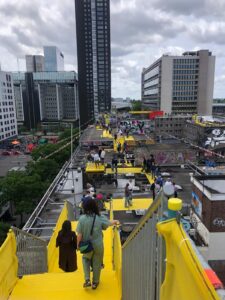
Arriving in Rotterdam was an unexpected opportunity to visit the brilliant ‘Walk the block’ experience on the rooftops and spaces of the city – and a project that feels very NEB aligned. Reimagining what our cities and places are like and can be, seeing things (quite literally) from another point of view, and bringing together design, engineering, architecture, ecological and the wider arts.
I feel an affiliation between my city of Glasgow in Scotland and Rotterdam – their mixture of old and new architecture, port cities with an industrial past, ‘second’ to their ‘prettier’ neighbouring cities (Edinburgh for us, Amsterdam for Rotterdam). What could Glasgow do like this event? It has so many interesting spaces and stories related to water and history. Recent productions I have led in my work include the Strathclyde Water Walk and Civic Street : Canal Cycle Route are a nod to these spaces and stories.(Maps are available as digital images or as beautifully printed A3 printed maps.)
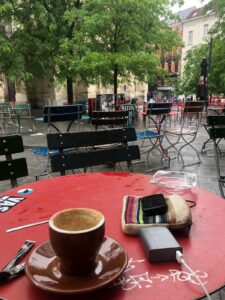
So here I am in Rotterdam, in the Netherlands, and ‘Walk the Block’ has turned my mind towards the NEB festival in Brussels. I’ve a couple of Dutch contacts to make, and then should I start cycling back to Belgium (probably into a headwind), or is time for a train? I’ll go to the café first, recharge a bit, and then move from there…
[Ends]
Next time…
Will James make it from Rotterdam to the NEB Festival on time? Or will he get stuck in the oceans of e-scooters in Brussels on the last leg? Part two in this blog series is coming soon!